One would not expect an article on flora to begin in a kitchen. Yet mine does.
The reason behind it is a gently simmering casserole of sweet Koukoumeli jam-to-be filling the house with its fragrant scent. For, would you not agree with me that there is something deeply satisfying in harvesting from nature and making your own "spitiko" (homemade) products? The financial side aside, gardening and cultivating land used to be one of the most essential survival skills of the islanders in not so distant past!
The months of June and July offer a profusion of herbs, fruit and vegetables to gather and dry, cook, bake, preserve and pickle. So, let us have a closer look at some of them. While black and white mulberries are over by the end of June, Mirabel prunes "koukoumeli", apricots "verikoka" and almonds "mandoles" are abundant and extremely good. In the vegetable garden, it is time to dig up golden new potatoes, to harvest kilo after kilo of zucchini "kolokithia", followed by clusters of sun-ripe tasty tomatoes and the dark-purple staple vegetable of Greece - the aubergine or "melintzana".
Did you know that not very long ago the eggplant was considered and exotic vegetable in most of Europe? By contrast, in India and China, where it originated, it has been one of the favourite vegetables for thousands of years. The aubergine was introduced to Italy in the late 16th century by the Arabs and the cultivation soon spread though the southern Mediterranean region. The aubergine was given the name eggplant because of the shape of the original fruit, which was white and roughly the size of a hen's egg.
Nowadays, a large number of variations in shape, size and colour exist, although the variety most commonly grown in Greece is a slender, dark-purple, pear-shaped fruit. Curiously, the origin of the Greek word melintzana could be tracked back to Italy too, where the fruit initially earned a derisive name mela insane, unhealthy apple, as it was reputed to cause feeblemindedness and other mental disorders.
It would be really truly insane to imagine Greek cuisine without the aubergine!
The "melintzana" could be prepared in so many appetising ways in moussakas, briam, parmigiana, papoutsakia, melintzanes yakhni or tiganites. And of course my personal favourite: the melintzano salata or pureé. This, however, must be home-prepared from smoked aubergines, garlic and olive oil only - strictly no mayo - and as such becomes a simple but surprising delicacy of the local cuisine.
Talking about eggplants brings me on to another two fascinating members of the Solanaceae family - the Thorn apple (Datura stramonium) and the Angel's trumpet (Brugmansia candida).
Both plants, although natives of India and South America, are perfectly at home in Greece.
The Thorn apple may have escaped your attention, since it grows on waste land as a low spreading shrub. Its flowers are white trumpets and its walnut-sized seed cases are round, green and spiny, rather like a thorn apple or as some more daringly call it "Devil's balls".
The Angel's trumpet, on the other hand, grows into a small tree which produces a great number of pendulous very attractive large trumpet-shaped flowers in white, yellow or peach colour.
Both plants are poisonous and contain high levels of alkaloids and a narcotic.
This has been exploited by the native Navajo people in their medicine and rituals. Their advice is as follows: "Eat a little, go to sleep. Eat some more, have a dream. Eat more and don't wake up."
Just in case anyone's tempted, it is not generally recommended for recreational use because it is so easy to mistake the dosage and kill yourself and also because of the startling side effects, summed up as: "blind as a bat, mad as a hatter, red as a beet, hot as hell, dry as a bone".
In July the temperatures soar and the onslaught of the summer drought sets in. This has an adverse effect on all growing things and in the gardens the richly floriferous time is over. However, a few species will manage to keep up a brave show of colour and scents. Bougainvilleas (Bougainvillea spectabilis), Plumbagos (Plumbago capensis), Oleanders (Nerium Oleander), Trumpet vine (Campsis grandiflora) are among the well known beauties.
But July also has a number of not-so-common exotic species; Jacaranda (Jacaranda mimosifolia) is a beautiful tree with light-green fern-like leaves and blue-purple bells of blossoms borne in large clusters. Jacaranda "Yiakaranda" is a subtropical tree native to South America, namely Bolivia and Argentina. It will thrive in sunny sheltered frost-free position and reward the gardener with its stunning floral display that lasts for several weeks. Indeed, there is a Jacaranda tree in Fontana that appears as a totally blue mass throughout June.
Peacock flower (Caesalpina gilliesii) is a small but showy tree. Surprisingly, it is one of the toughest plants in the garden. It flowers throughout the summer and the flowers arranged in terminal racemes are striking orangey-yellow, owing nothing to the plant's fancy name. Again, there is a small tree in Fontana in full bloom at the time of writing if you'd like to see for yourself.
An interesting native representative of this month's flora is the Chaste tree (Vitex agnus-castus) or "Ligaria". The genus name derives from the Latin viere - to plait and in fact, the strong, flexible branches of this shrub were used to bind slaves. A legend also tells how Ulysses used these branches to bind his companions under the bodies of the sheep when they escaped from Polyphemus' cave. The species name, instead, does not derive from the Latin agnus - lamb, but from the Greek hagnos (pure, chaste) and the Latin castus of the same meaning.
According to myth, Hera, the protectress of marriage, was born under this shrub. Women declaring chastity would lay on a pallet plaited of its branches. On Paxos it is said that if a girl gives a Chaste tree spring to her boyfriend it will keep him faithful to her.
Botanically, the Chaste tree is a delightfully aromatic shrub with compound palmate leaves bearing long spikes of white to lavender-blue flowers resembling Lilac flowers. Its sweet scent always attracts a host of butterflies and other insects. It usually grows near fresh water source and there is a fine example on Antipaxos, by the cistern of Kaloyiri.
In the wild, flowers are becoming scarce in June and July. But if you are prepared to take a stroll to your favourite beach, rather than drive there, and take time to explore the coastal areas you will still be rewarded by a delightful display of wild flowers and plants many of which are edible or could be used as herbs with recognized medicinal properties.
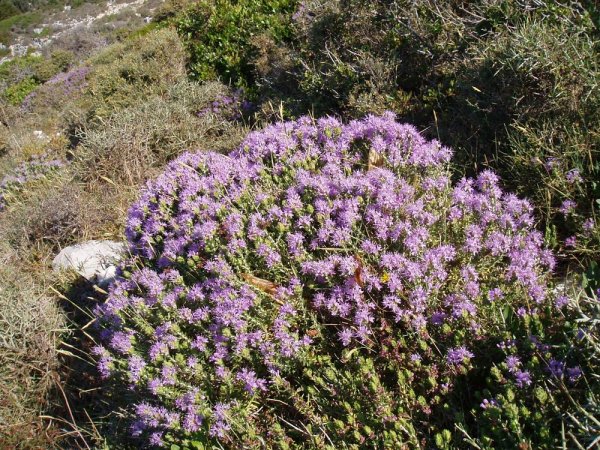
The rocky areas near the seashore dominated by highly adapted group of ground hugging, cushion-shaped, spiny and often aromatic shrubs are called phrygana. The phrygana is home to the one plant that must not escape your attention this month - the thyme (Thymus capitatus) or Thymari. Its lilac-coloured blossoms make
28
cool-looking patches all over the west coast hillsides and bees are its assiduous visitors. The honey they produce is a well-known and treasured island's product.
The dried leaves of Thymari are similar in scent to oregano (Origanum vulgare) or Rigani and the two herbs help to bring "the great outdoors" to many local dishes.
Another native plant that is in its best during the months of June and July is the myrtle (Myrtus communis) or Myrtia. The myrtle grows everywhere on Paxos and this may be the reason why we often overlook its aesthetic properties. It has glossy aromatic foliage, swollen white buds that open into bursts of dainty cream-coloured fragrant flowers each with a mass of fluffy stamens.
Legend tells us that when the beautiful goddess of love Aphrodite was born from the foam of the waves, where the sperm of her father Cronus had fallen, she came out of the sea and ran to hide her naked beauty behind a myrtle bush. Ever since the myrtle was sacred to her and became a classical symbol of everlasting love, peace and honour.
The last two species I would like to mention this month have been known to humanity since antiquity. They can be found growing on the most extreme locations of open cliffs, on beaches and near the shoreline. Here, the sturdy plants are exposed to incessant sunshine, unforgiving drought, wind and salty sea mist. Still, they cling to life and thrive!
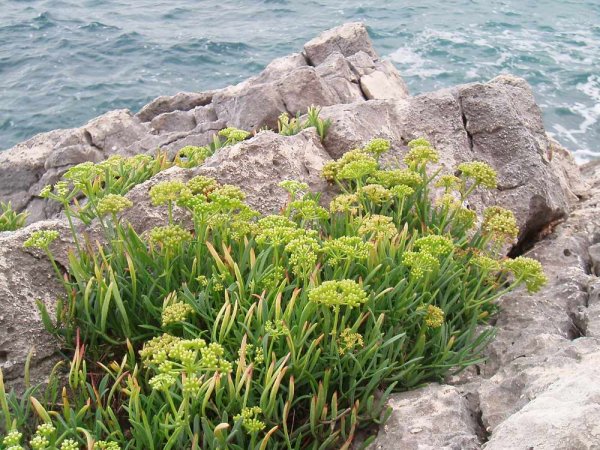
One of them is rock samphire (Crithmum maritimum) or sea fennel, know locally as Cymbala.
The plant has silvery-green fleshy leaves that are edible if collected before the flowering period. They can be eaten in small quantities in salads or blanched and pickled in brine. The plant is rich in vitamin C and mineral salts and for that reason Ancient Greek fishermen used to take barrels of pickled samphire on long voyages to prevent scurvy.
The other peculiar culinary plant is capers (Capparis spinosa) or Kapparis. The caper has spectacular flowers that last only one day. It grows over rocks as a low spreading bush with long straggling stems. The leaves are round dark-green, somehow leathery and are collected by the locals together with the tender flower buds to be pickled or made into a delicious refreshing summer salad.
Indeed, a caper gathering trip could be a lot of fun! It usually entails an adventurous trip by boat to the west side of Antipaxos or even further to the island of Daskalia where on the rocky shore the capers abound.
Both local delicacies - samphire and caper salads - can still be occasionally found on the menus of some the more imaginative taverns and certainly won't disappoint you!
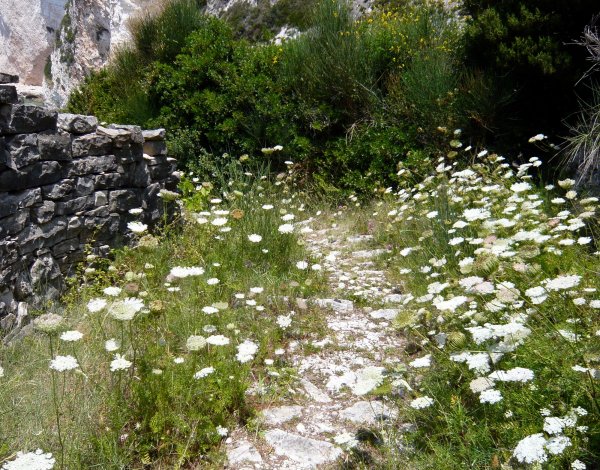
There are a number of plants and flowers that didn't get mentioned and yet deserve your attention; such as hollyhocks (Alcea rosea) or Dhendhromolkha providing magnificent colour and sculpture in the countryside, the ubiquitous umbellifer wild carrot (Daucus carota) or Agriokaroto. Did you notice that its tall white flower-heads each sport a dark dot the size of a bug right in the middle. It's a subtle way in which the plant attracts more insects to land on its pad and pollinate. The sweet scented cream-coloured clematis (Clematis flammula) or Ambelina cascading over every dry-stone wall and even climbing trees and the tall stands of feathery leaved fennel (Foeniculum vulgare) or Maratho which lends its characteristic pleasant smell to many local dishes.
Last but not least I would like to give a big "Thumbs up" to the Demos and the team of botanists from the university of Drama for researching, assembling and publishing an exquisitely illustrated study of flora of Paxos & Antipaxos. The book is a priceless addition to the already existing publications on Paxos and as such deserves a full review on its own